How online learning has evolved to be more engaging than ever
As remote education gains in popularity, new expertise and resources help instructors keep students involved.
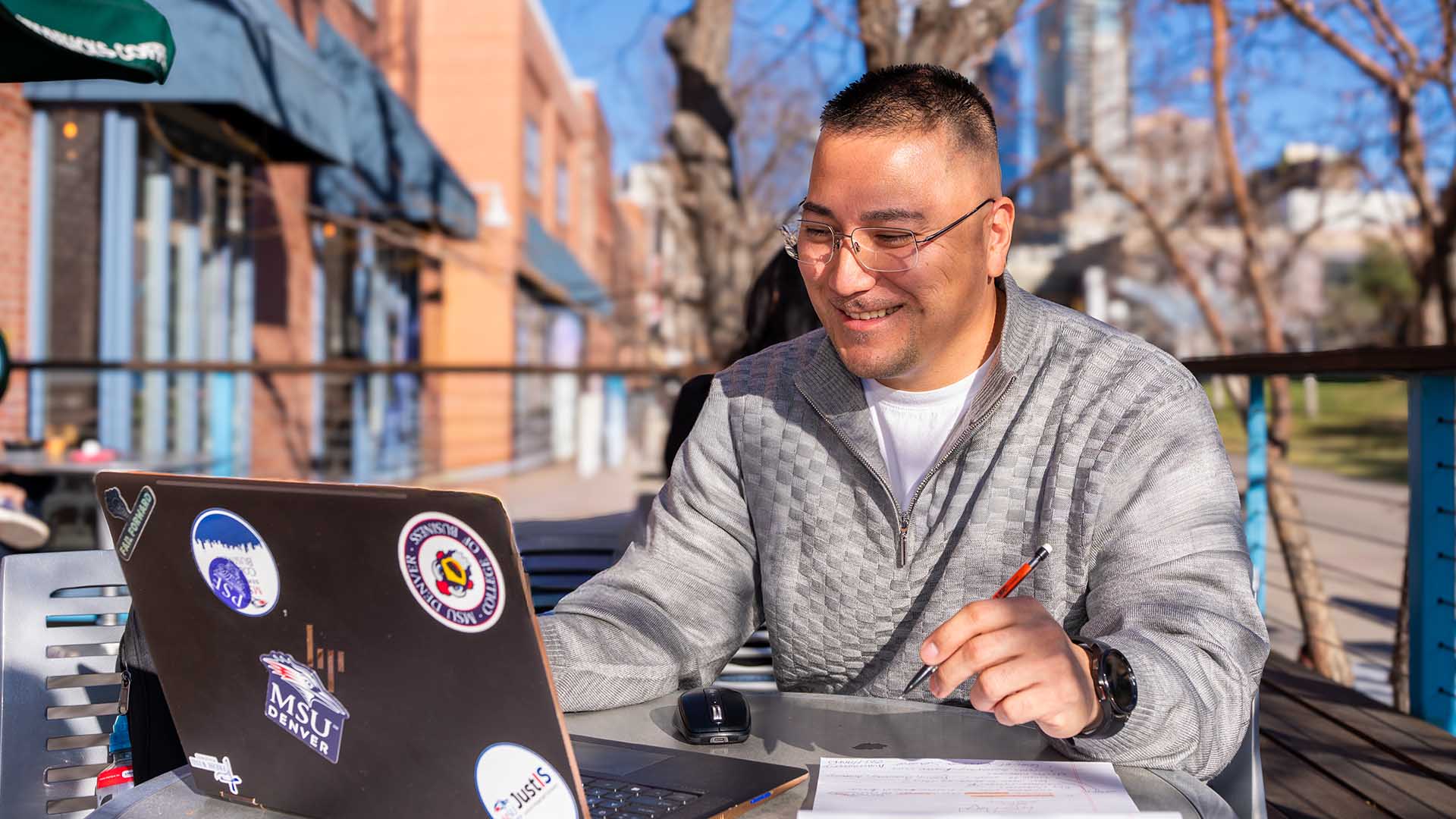
Business Management major is earning his degree online.
“I just like the convenience,” said Nakamura, who’s juggling coursework with running a business, leading a student organization, fatherhood and a part-time job.
That convenience factor is hard to dispute, and it undoubtedly is helping drive the growing popularity of online learning.
In 2024, nearly 54% of college students were taking online or distance courses, according to the Integrated Postsecondary Education Data System, IPEDS. And while a sizeable majority of high school students expecting to attend college say they prefer an on-campus experience, only 13% of nontraditional adult students and 12% of prospective graduate students say they want fully in-person learning, according to Encoura, an education technology company.
Online classes at MSU Denver
More than 78,000 credit hours worth of online classes were taken by almost 11,000 MSU Denver students in fall 2025.
Convenience is a major driver of online learning, said Sam Jay, Ph.D., professor of Communication Studies and executive director of Online Learning at MSU Denver.
The shift, Jay suspects, represents a generational change. “We’re in a weird time. People 15 to 25 seem to value individualized experiences. The social component that previous generations valued doesn’t seem to be as important.”
That may be yet another social shift ushered in by the pandemic.
When COVID-19 suddenly sent everyone home, educators from kindergarten teachers to graduate-level professors rushed to transform years of in-person teaching experience into virtual learning.
It was rough, but everyone seemed to realize students and educators alike were doing their best in a bad situation. Now, though, effective online education takes more than an instructor uploading content and quizzes and telling students to have at it.
That’s where the Office of Online Learning, and the Center for Teaching, Learning and Design can help. In the past five years, educators have learned a great deal about how to create meaningful online learning experiences, and the experts in those offices constantly share their expertise, resources and strategies with MSU Denver faculty.
RELATED: Future Proof: Computer Science majors learn to collaborate with AI
For example, Shannon Donnelly, a School of Hospitality instructor, created an activity called “pathways and perspectives through the war on drugs” for her online Cannabis 101 for Hospitality class. In it, she randomly assigns students various identities, with different backgrounds, ethnicities and skill sets, and asks them to navigate various situations to see who is arrested, who isn’t, who is able to open a dispensary and who isn’t.
“It gives Gen Z students a lot of historic knowledge,” Donnelly said. “Since they’ve been alive, cannabis in some form has been legal.”
The activity was extra work. “I could have just given them a map and said, ‘This is where redlining happened,’” she said. But the activity made it real, made it personal.
More than 78,000 credit hours worth of online classes were taken by almost 11,000 MSU Denver students in fall 2025.
Far from being an easy way out for instructors, online — and especially asynchronous classes — often make extra demands on educators. Philip E. Bernhardt, Ph.D., professor of Secondary Education, uses an annotation feature that prompts students to address a question based on required reading. “They have a due date to post a response, and a due date to respond to classmates” he said. “We can see everybody annotating a document.” He also drops in often to join virtual conversations, a strategy that lets students know he, too, is engaged.
Bernhardt has found that “in an asynchronous environment, if you don’t participate regularly (students) disappear. Because they don’t think anybody’s there.”
Online learning may never replace the experience of sitting in a classroom, meeting peers and working directly with an instructor. But for many students, online has become the preferred learning method — and for others the necessary one.
That means educators must be agile and adapt, Jay said. “At MSU Denver there is a charisma factor,” he said. When faculty talk to students in person about topics that excite them, that passion is palpable, he said. “We have to do our best to replicate that in the online space. That requires a rethinking of how we create that same level of passion online.”