Serving those who’ve served time
MSU Denver’s JustIS program provides connection, services and hope for students impacted by the justice system.

This story appears in the spring 2026 issue of MSU Denver Magazine.
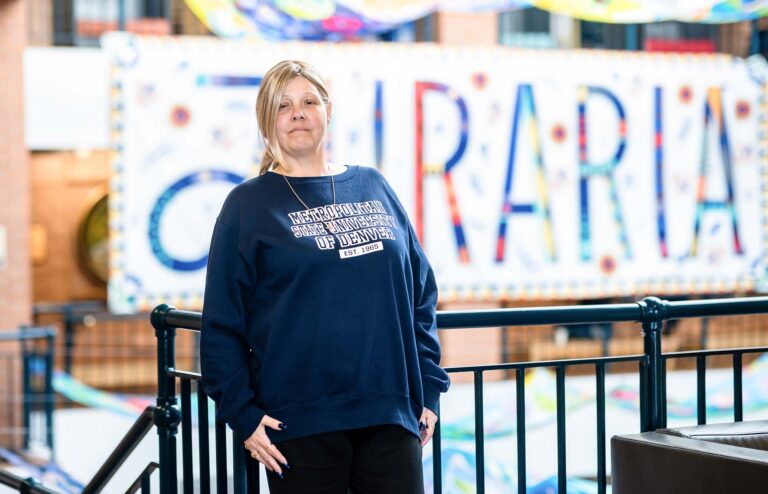
When Adam Nakamura first enrolled in classes at Metropolitan State University of Denver, he was eager, enthusiastic and in a hurry. But within days, that bumped up against a hard reality: He didn’t know the first thing about being a college student. “I took four summer-school classes. I had no idea that in summer everything was condensed,” Nakamura said. There were a lot of other things he didn’t know, too, like how to use a smartphone, the correct protocol for responding to email, how to get a bus pass.
But his biggest problem was that, after seven years in prison, he didn’t know what he didn’t know.
That he stuck with it is a testament to Nakamura’s tenacity. Not everyone in his situation is so determined. According to a Prison Policy Initiative report, the odds of a formerly incarcerated person earning a college degree are less than 1 in 20, compared with one in three for the general public.
Nakamura is determined to defy those odds. And J. Renee Trombley, Ph.D., associate professor of Criminal Justice and Criminology, is determined to help him, and others like him, succeed.
In 2022, Trombley, who prefers to go by J., launched the Justice Impacted Scholar Alliance, or JustIS Alliance, at MSU Denver to offer support, resources and community for students who have been impacted by the justice system. That includes those who have been adjudicated as juveniles or adults — or both — and the loved ones of those who have been, she said.
It was something the University had wanted to do, and J. got the opportunity to develop the project. She has a “three-part vision” for the initiative: supporting it on campus, supporting the student organization, and establishing a network that includes the MSU Denver community and the greater Denver area.
JustIS conducted a survey last semester and plans another one this spring to determine how many students could benefit from the organization and their most pressing needs. Roughly 45 students responded, J. said, and made their needs clear. “Money for scholarships and housing. Housing insecurity comes up a lot,” she said. “And they also are looking for work.”
The JustIS website lists employers willing to hire formerly incarcerated people. And, in addition to regular meetings and outreach on campus, the program provides connections to organizations that offer everything from housing services and child care to GED prep and testing.
For Nakamura, the program did something else. “I saw a flyer for JustIS on campus. And I thought, ‘What?! I’m not the only one?’”
Nakamura is far from the only person to be released from prison. According to the U.S. Department of Justice, 95% of incarcerated people will be released eventually.
J. also is part of that majority.
As a child in foster care, she developed a habit of taking things out of other people’s mailboxes. “I had always loved reading, and I honestly just wanted something to read,” she said. But law enforcement “thought I was part of some organized crime ring stealing people’s checks.”
That “was the beginning of many years on the run and in the streets and dealing with the system.” By the time her legal troubles ended, she had three kids and no clue what to do next.
“I remember once sending a prayer out: ‘What am I going to do with my life?’ I heard a small spirit saying, ‘You’re going to be a doctor one day.’ I was like, ‘No way, I don’t like blood.’”
RELATED: He served nine years in prison. Now he’s mayor of his hometown.
But she did like school, and she was smart. When she discovered that community colleges didn’t screen out people with criminal records, she enrolled. “I was excited but struggling. I dropped out.”
It was a call from a caring instructor urging her to come back that changed her life, she said. That and financial aid.
Not that the rest was easy. “I’ve been shunned and talked about and told never to tell the truth about my story,” she said.
Despite all that, she became a doctor after all, earning a Ph.D. in juvenile justice.
The multitude of studies confirming that education helps prevent people from returning to prison could themselves fill a prison. In 2023, researchers at the Mackinac Center for Public Policy and Middle Tennessee State University reviewed many of those studies. They concluded that prison workforce and education programs reduce the likelihood of returning to prison by 15% and increase the chances a former offender will find a job by 7%.
Many prisons offer high school equivalency certificates and those help reduce recidivism. But, “formerly incarcerated people who were able to get a college degree … have lower recidivism rates,” according to a study led by Arizona State University researchers.
Before 1994, about 350 programs offered college credit for incarcerated people. That year, Congress passed a tough-on-crime law that eliminated financial aid for people in prison. By 2005, the number of in-prison college programs had dropped to 12, according to the Prison Policy Initiative.
In prison, Nakamura said, he read constantly, and that drove his desire for education. Like J., he considers himself fortunate to have gotten help. His sister let him sleep on her couch for a year. His TRIO student success navigator and peer mentors in the C2Hub came through for him. A faculty advisor referred him to the Student Care Center. “I didn’t know whether to be offended or what. But I ended up being grateful. They helped a lot.”
Otherwise, “I definitely would have quit,” he said.
In four years at MSU Denver, the Management major has started a home maintenance business, become president of JustIS, kept a 3.0 GPA and been able to be a parent to his four kids. He won a $500 check from the Launch Denver business startup program for his concept, providing backpacks filled with essentials to newly released prisoners.
Now, he’s considering a second major, Psychological Sciences, so he can counsel others coming out of prison.
He has another goal: being the role model for his own kids that he never had growing up.